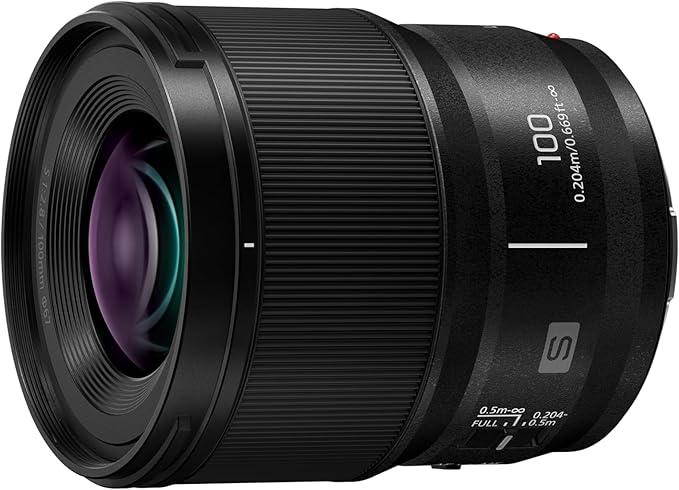
Panasonic Lumix G Macro 30mm f/2.8 ASPH. Mega O.I.S. Lens
Designed for close-up shooting the LUMIX G MACRO 30mm f2. MEGA O. I.S. is a 60mm-equivalent prime lens designed for Micro Four Thirds mirrorless digital cameras. Its macro capabilities enable a minimum focusing distance of 4. 1 along with a 11 magnification ratio for life-size imaging of nearby subjects. One aspherical element helps to control chromatic aberrations and distortions and a multi-layer coating reduces ghosting and lens flare for increased contrast and color fidelity. In addition to the optical performance the lens also features a MEGA Optical Image Stabilizer O. I.S. which compensates for the effects of camera shake for sharper hand-held shooting. A stepping AF motor and internal focusing design offer fast smooth and near-silent focusing performance and the rounded 7-blade diaphragm contributes to a pleasing out-of-focus quality when working with selective focus and shallow depth of field techniques.
Designed for close-up shooting the LUMIX G MACRO 30mm f2. MEGA O. I.S. is a 60mm-equivalent prime lens designed for Micro Four Thirds mirrorless digital cameras. Its macro capabilities enable a minimum focusing distance of 4. 1 along with a 11 magnification ratio for life-size imaging of nearby subjects. One aspherical element helps to control chromatic aberrations and distortions and a multi-layer coating reduces ghosting and lens flare for increased contrast and color fidelity. In addition to the optical performance the lens also features a MEGA Optical Image Stabilizer O. I.S. which compensates for the effects of camera shake for sharper hand-held shooting. A stepping AF motor and internal focusing design offer fast smooth and near-silent focusing performance and the rounded 7-blade diaphragm contributes to a pleasing out-of-focus quality when working with selective focus and shallow depth of field techniques.
Designed for close-up shooting the LUMIX G MACRO 30mm f2. MEGA O. I.S. is a 60mm-equivalent prime lens designed for Micro Four Thirds mirrorless digital cameras. Its macro capabilities enable a minimum focusing distance of 4. 1 along with a 11 magnification ratio for life-size imaging of nearby subjects. One aspherical element helps to control chromatic aberrations and distortions and a multi-layer coating reduces ghosting and lens flare for increased contrast and color fidelity. In addition to the optical performance the lens also features a MEGA Optical Image Stabilizer O. I.S. which compensates for the effects of camera shake for sharper hand-held shooting. A stepping AF motor and internal focusing design offer fast smooth and near-silent focusing performance and the rounded 7-blade diaphragm contributes to a pleasing out-of-focus quality when working with selective focus and shallow depth of field techniques.
Designed for close-up shooting the LUMIX G MACRO 30mm f2. MEGA O. I.S. is a 60mm-equivalent prime lens designed for Micro Four Thirds mirrorless digital cameras. Its macro capabilities enable a minimum focusing distance of 4. 1 along with a 11 magnification ratio for life-size imaging of nearby subjects. One aspherical element helps to control chromatic aberrations and distortions and a multi-layer coating reduces ghosting and lens flare for increased contrast and color fidelity. In addition to the optical performance the lens also features a MEGA Optical Image Stabilizer O. I.S. which compensates for the effects of camera shake for sharper hand-held shooting. A stepping AF motor and internal focusing design offer fast smooth and near-silent focusing performance and the rounded 7-blade diaphragm contributes to a pleasing out-of-focus quality when working with selective focus and shallow depth of field techniques.
in 16 offers
The lowest price for Panasonic Lumix G Macro 30mm f/2.8 ASPH. Mega O.I.S. Lens right now is $269.55 at eBay.com.au, compared across 16 retailers.
The all-time low was $199.00 on 26 Aug 2024 — today's price is 35% above the lowest ever. It has been notably cheaper before — worth setting a price alert.
Prices last updated 16 Sept 2026.
Last updated at 16/09/2026 19:42:28
Panasonic Lumix G Macro 30mm f/2.8 ASPH MEGA OIS MFT Lens 46mm
Affiliate Disclosure: We may receive a small commission for purchases made through this link at no extra cost to you. This helps support our site. Thank you!
Panasonic LUMIX G 30mm f/2.8Macro
Delivery between 23–28 Sept $8.95
Panasonic Lumix G 30mm f/2.8 ASPH Mega O.I.S. Macro Lens
Delivery $9.90
Panasonic Lumix G f/2.8 Macro Lens, 30mm
Free delivery between 21–30 Sept
Panasonic LUMIX G 30mm F/2.8 HHS030E Black (Retail Packing)
Delivery $50
Panasonic Lumix G MACRO 30mm f/2.8 ASPH. MEGA O.I.S. Lens
Free delivery
Panasonic Lumix G 30mm F2.8 ASPH MEGA OIS Macro Lens Micro Four Thirds Mount With 1to1 Magnification
Delivery $9.95
Panasonic Lumix G Macro 30mm f/2.8 ASPH MEGA OIS Lens
Delivery between 21–24 Sept $12.90
Panasonic Lumix G 30mm f/2.8 Macro Lens
Free delivery
Panasonic LUMIX G 30mm f/2.8 Macro Lens
Delivery between Sat – Wed $10
originally posted on bhphotovideo.com
I do a lot of close-up shootings, so I decided to get this lens when it was on a discounted price. I was attracted that the lens features a MEGA O.I.S. system, which compensates for the effects of camera shake for sharper hand-held shooting. It's a very useful tool to have if you do hate carrying a tripod all the time.The lens is a 60mm-equivalent prime lens designed for Micro Four Thirds mirrorless digital cameras. Its macro capabilities enable a minimum focusing distance of 4.1 along with a 1:1 magnification ratio for life-size imaging of nearby subjects.I am very pleased with it and you should try this lens if you love doing close up photography with your macro four thirds camera.
originally posted on bhphotovideo.com
30mm is my favorite walk-around lens for MFT. I like a little compression, especially for portraits. I agonized over the Panasonic 30 2.8 micro and the new Sigma 30mm 1.4 lens. I ordered the Sigma lens but returned it after a few test shots; too many artifacts and purple fringing. The Panasonic lens passed testing with crystal clear shots (yes, I am a pixel peeper at 14x). Losing two f/stops doesn't bother me, especially given the multi-stop stabilization in today's MFT cameras/lenses. At 5 feet (portrait range), the depth of field at f/1.4 is only 3.5; one often has to choose between having an eye or an ear in focus but not both. At f/2.8, the depth of field is 8.5 ... good enough to have the head in focus with a pleasant bokeh in the background. The fact that the ... More30mm is my favorite walk-around lens for MFT. I like a little compression, especially for portraits. I agonized over the Panasonic 30 2.8 micro and the new Sigma 30mm 1.4 lens. I ordered the Sigma lens but returned it after a few test shots; too many artifacts and purple fringing. The Panasonic lens passed testing with crystal clear shots (yes, I am a pixel peeper at 14x). Losing two f/stops doesn't bother me, especially given the multi-stop stabilization in today's MFT cameras/lenses. At 5 feet (portrait range), the depth of field at f/1.4 is only 3.5; one often has to choose between having an eye or an ear in focus but not both. At f/2.8, the depth of field is 8.5 ... good enough to have the head in focus with a pleasant bokeh in the background. The fact that the Panasonic lens is a macro lens has the advantage (characteristic of macros) of having a flat field in crystal-clear focus from f/2.8 to f/8, after which diffraction starts. I may never use the Panasonic macro capability, but it is there if I need it.
originally posted on bhphotovideo.com
I bought this lens 4 or 5 years ago and always thought well of it. One day while taking pictures of old pictures instead of scanning (though it's really hard to eliminate ambient light) I tried taking photos of old 35 mm film negatives by taping them to a window for back-light. Results were impressive after applying the 'negative' filter in Photoshop.Then came the Lumix G9, which I love. Then this year (2022) a pro-photographer friend of mine (MK) loaned me Negative Supply's back light rig and negative carrier for 35 mm film that allows you to easily photograph all your negatives and while keeping them substantially flat, without scratching.This lens, combined with the G9's 40 and 80 MP high definition mode has brought new life to my 30 years of 35 mm film ... MoreI bought this lens 4 or 5 years ago and always thought well of it. One day while taking pictures of old pictures instead of scanning (though it's really hard to eliminate ambient light) I tried taking photos of old 35 mm film negatives by taping them to a window for back-light. Results were impressive after applying the 'negative' filter in Photoshop.Then came the Lumix G9, which I love. Then this year (2022) a pro-photographer friend of mine (MK) loaned me Negative Supply's back light rig and negative carrier for 35 mm film that allows you to easily photograph all your negatives and while keeping them substantially flat, without scratching.This lens, combined with the G9's 40 and 80 MP high definition mode has brought new life to my 30 years of 35 mm film negatives. I am not a professional, but this lens/camera combo blows me away. I can punch in focus and easily see film grain on 100 ISO film. I use manual focus, set the shutter on 4 sec delay, aperture at F/5.6 for great results in JPEG mode by using the natural setting, turning sharpness, contrast and noise reduction all the way off & leaving saturation in middle. Haven't experimented much more.My sample photo is a photo of a negative with this lens and G9, which itself is a photo I took with my amazing and still working Yashica T4 SuperD with its Zeiss 35 mm F/3.5 Tessar, which I bought from B & H in 1996.Ironically, this lens and the G9 are getting me back into film, I just bought a 6 x 9 folder camera. Used, because they don't make them anymore. Sigh.
| General | |
| Length | 6.35 cm |
| Diameter | 5.88 cm |
| Weight | 180 g |
| Lens System |
Panasonic Lumix G Macro 30mm f/2.8 ASPH MEGA OIS MFT Lens 46mm
Affiliate Disclosure: We may receive a small commission for purchases made through this link at no extra cost to you. This helps support our site. Thank you!
Panasonic LUMIX G 30mm f/2.8Macro
Delivery between 23–28 Sept $8.95
Panasonic Lumix G 30mm f/2.8 ASPH Mega O.I.S. Macro Lens
Delivery $9.90
Panasonic Lumix G f/2.8 Macro Lens, 30mm
Free delivery between 21–30 Sept
Panasonic LUMIX G 30mm F/2.8 HHS030E Black (Retail Packing)
Delivery $50
I do a lot of close-up shootings, so I decided to get this lens when it was on a discounted price. I was attracted that the lens features a MEGA O.I.S. system, which compensates for the effects of camera shake for sharper hand-held shooting. It's a very useful tool to have if you do hate carrying a tripod all the time.The lens is a 60mm-equivalent prime lens designed for Micro Four Thirds mirrorless digital cameras. Its macro capabilities enable a minimum focusing distance of 4.1 along with a 1:1 magnification ratio for life-size imaging of nearby subjects.I am very pleased with it and you should try this lens if you love doing close up photography with your macro four thirds camera.
30mm is my favorite walk-around lens for MFT. I like a little compression, especially for portraits. I agonized over the Panasonic 30 2.8 micro and the new Sigma 30mm 1.4 lens. I ordered the Sigma lens but returned it after a few test shots; too many artifacts and purple fringing. The Panasonic lens passed testing with crystal clear shots (yes, I am a pixel peeper at 14x). Losing two f/stops doesn't bother me, especially given the multi-stop stabilization in today's MFT cameras/lenses. At 5 feet (portrait range), the depth of field at f/1.4 is only 3.5; one often has to choose between having an eye or an ear in focus but not both. At f/2.8, the depth of field is 8.5 ... good enough to have the head in focus with a pleasant bokeh in the background. The fact that the ... More30mm is my favorite walk-around lens for MFT. I like a little compression, especially for portraits. I agonized over the Panasonic 30 2.8 micro and the new Sigma 30mm 1.4 lens. I ordered the Sigma lens but returned it after a few test shots; too many artifacts and purple fringing. The Panasonic lens passed testing with crystal clear shots (yes, I am a pixel peeper at 14x). Losing two f/stops doesn't bother me, especially given the multi-stop stabilization in today's MFT cameras/lenses. At 5 feet (portrait range), the depth of field at f/1.4 is only 3.5; one often has to choose between having an eye or an ear in focus but not both. At f/2.8, the depth of field is 8.5 ... good enough to have the head in focus with a pleasant bokeh in the background. The fact that the Panasonic lens is a macro lens has the advantage (characteristic of macros) of having a flat field in crystal-clear focus from f/2.8 to f/8, after which diffraction starts. I may never use the Panasonic macro capability, but it is there if I need it.
I bought this lens 4 or 5 years ago and always thought well of it. One day while taking pictures of old pictures instead of scanning (though it's really hard to eliminate ambient light) I tried taking photos of old 35 mm film negatives by taping them to a window for back-light. Results were impressive after applying the 'negative' filter in Photoshop.Then came the Lumix G9, which I love. Then this year (2022) a pro-photographer friend of mine (MK) loaned me Negative Supply's back light rig and negative carrier for 35 mm film that allows you to easily photograph all your negatives and while keeping them substantially flat, without scratching.This lens, combined with the G9's 40 and 80 MP high definition mode has brought new life to my 30 years of 35 mm film ... MoreI bought this lens 4 or 5 years ago and always thought well of it. One day while taking pictures of old pictures instead of scanning (though it's really hard to eliminate ambient light) I tried taking photos of old 35 mm film negatives by taping them to a window for back-light. Results were impressive after applying the 'negative' filter in Photoshop.Then came the Lumix G9, which I love. Then this year (2022) a pro-photographer friend of mine (MK) loaned me Negative Supply's back light rig and negative carrier for 35 mm film that allows you to easily photograph all your negatives and while keeping them substantially flat, without scratching.This lens, combined with the G9's 40 and 80 MP high definition mode has brought new life to my 30 years of 35 mm film negatives. I am not a professional, but this lens/camera combo blows me away. I can punch in focus and easily see film grain on 100 ISO film. I use manual focus, set the shutter on 4 sec delay, aperture at F/5.6 for great results in JPEG mode by using the natural setting, turning sharpness, contrast and noise reduction all the way off & leaving saturation in middle. Haven't experimented much more.My sample photo is a photo of a negative with this lens and G9, which itself is a photo I took with my amazing and still working Yashica T4 SuperD with its Zeiss 35 mm F/3.5 Tessar, which I bought from B & H in 1996.Ironically, this lens and the G9 are getting me back into film, I just bought a 6 x 9 folder camera. Used, because they don't make them anymore. Sigh.
Very easy to use lens with macro, focusing fast on both Lumix G7 and G9.It is in pristine condition with no descernible marks or damage.This is my second used lens bought from Wex and I would buy again.Just a shame the box had stickers all over it. I mentioned it to Wex and they don't think they will be changing this pratice anytime soon.
I started to build my 4/3 system 2 years ago with a GM1 that I bought to complement my Nikon D800 (with the f/1.4 Nikon primes) and my Leica M9 (with the 21/35/50/75 Leica primes). I was so impressed by my results, that I quickly expended with a GM5, and the Panasonic/Leica lenses 15mm and 42.5, both amazing. I was looking forward for a high end Pana/Leica offering in the 20-30mm range that would have the manual aperture setting, but this did not come. When this new 30mm micro came, I decided to try it. Well, it does not have any aperture ring, nor the Leica sticker, but I can tell that this little lens could have been named Leica too. Sharp, No distortion (raw files), very neutral in color rendition... and soooo small! I recently compare the GM5 results with this ... MoreI started to build my 4/3 system 2 years ago with a GM1 that I bought to complement my Nikon D800 (with the f/1.4 Nikon primes) and my Leica M9 (with the 21/35/50/75 Leica primes). I was so impressed by my results, that I quickly expended with a GM5, and the Panasonic/Leica lenses 15mm and 42.5, both amazing. I was looking forward for a high end Pana/Leica offering in the 20-30mm range that would have the manual aperture setting, but this did not come. When this new 30mm micro came, I decided to try it. Well, it does not have any aperture ring, nor the Leica sticker, but I can tell that this little lens could have been named Leica too. Sharp, No distortion (raw files), very neutral in color rendition... and soooo small! I recently compare the GM5 results with this lens to the Nikon D800 with the Micro Nikkor 60mm f2.8. Both camera at 200 ISO, f/4, for a group photo on tripod. Well, even on a 8x10 print, you see how the Panasonic GM5 and this 30mm is much more consistent in corner to corner quality, even using the Nikon Profile on Adobe Aperture on the Raw file. Here is what I think at this point: the 4/3 system has beendesign from ground up for digital imaging. While the Nikon system has a lot to carry-on from legacy film Nikon system. And the results show this. the micro-Nikkor was a reference lens... 15 years ago. Not any more, and Nikon has no replacement on the horizon. Bottom line: Nikon system needs a complete overall to be relevant again in the market place, facing 4/3 and Sony and Fuji mirrorless fantastic options. I chose Panasonic 4/3 so I can get the smallest camera available, high quality lenses (as this 30mm) and be able to use my manual Leica M lenses with an official adaptor. It works very well for me - the M lenses may be all manual, but they are also the smallest and highest quality full frame options on the market. When I shoot on a tripod, or I take the time alone, I go for the M9. When I shoot action and people, I go for the GM5 and its AF Pana/Leica lenses (and this 30mm). I do have the option to mix. the two systems when appropriate. Perfect!
This lens is my favorite gear purchase for quite some time. I have been using an adapted Nikon 60mm Macro 2.8 for more than a year, and it has worked pretty well, though it is quite specialized. Manual focus wasn't a problem on the Nikkor, because that is arguably the best way to use a macro. I enjoyed using it for portraiture, because you can get as close as you want and the defocused background looks pretty unique. But a 120mm equivalent makes direction of talent challenging, and the image stabilization on Olympus cameras does not line up exactly with 60mm. This is an Olympus issue, but it certainly affects the usability of the Nikon. You can enter the Olympus menu and manually set the sensor-shift stabilization calibration to the focal length of your lens. ... MoreThis lens is my favorite gear purchase for quite some time. I have been using an adapted Nikon 60mm Macro 2.8 for more than a year, and it has worked pretty well, though it is quite specialized. Manual focus wasn't a problem on the Nikkor, because that is arguably the best way to use a macro. I enjoyed using it for portraiture, because you can get as close as you want and the defocused background looks pretty unique. But a 120mm equivalent makes direction of talent challenging, and the image stabilization on Olympus cameras does not line up exactly with 60mm. This is an Olympus issue, but it certainly affects the usability of the Nikon. You can enter the Olympus menu and manually set the sensor-shift stabilization calibration to the focal length of your lens. Unfortunately, the Olympus settings are 55mm and 65mm, no 60mm. Enter the Panasonic 30mm Macro 2.8. I am not much of a macro shooter, but this lens works fantastically well for macro subjects. It offers a 1:1 reproduction ratio, but I rarely use this. A gripe with this lens is the relatively short working distance at 1:1 compromises the lens' capability as an insect shooter. Admittedly, if I were an insect shooter, I probably would have purchased the Olympus 60mm Macro, but I don't think it's a huge deal. I find I am usually far from filling the frame 1:1 when I get the composition I want for small objects. What I have primarily been using this lens as is a normal lens. In Micro Four Thirds, 25mm is considered normal (50mm equivalent), but I find the 30mm close enough. Recently, I used the lens for a portrait at work. Because I was working in a busy kitchen, my Olympus 45mm 1.8 was too long. I slapped on the 30mm and was very pleased with the results. It has uniform sharpness across the frame that the 45mm cannot match. However, the 45mm has perceptibly better peak sharpness in the center and is more contrasty. I prefer the color rendtion of Panasonic lenses, and the 30mm does not disappoint here. It is a very versatile lens great for walking around and covers everything from macro to reportage to portraits. It has zero distortion even when uncorrected by the camera (something that seems to be pretty rare on MFT lenses wider than 45mm). What don't I like about this lens? Answering that question is easy for quite a few of my lenses, but it is difficult for this one, but here we go. Olympus 5-axis image stabilization doesn't seem to be as effective on this lens, not even compared to my Panasonic 45-150mm. It works, but it isn't mindblowing like it is for my other lenses. I'm pretty sure it stems from the way the lens is used during macro shots: little vibrations translate to big shakes at macro distances. Under macro distances, the autofocus is a little slow (comparitively speaking, MFT lenses focus super fast). Again, this is under macro conditions, when manual focus is probably the better way to go. Perhaps my only substantive gripe is the lack of AF/MF switch. It would be nice to be able to rapidly switch between the modes without having to dive into a camera menu. This is rapidly becoming my favorite lens after my Olympus 45mm. Highly recommmended.
Ive used this lens a lot over the past 2 months. In fact, its been my main lens on my Panasonic G7 camera.This is a very nice lens, and lets you get in nice and close to whatever you are photographing. Ive enjoyed it quite a bit, and have to admit Im still learning good macro technique to use with this lens.However, as far as MACRO uses are concerned, I think I would get a longer focal length if I were to do this all over again. I knew the 30mm focal length would require a close lens-to-subject distance...but dang, you pretty much have to be Right on Top of the subject...with the lens nearly touching your subject!So, for the ability to get in as close as you want to shoot...this is a very nice normal/close focus lens. (Food Photography, Flowers, etc.) However, ... MoreIve used this lens a lot over the past 2 months. In fact, its been my main lens on my Panasonic G7 camera.This is a very nice lens, and lets you get in nice and close to whatever you are photographing. Ive enjoyed it quite a bit, and have to admit Im still learning good macro technique to use with this lens.However, as far as MACRO uses are concerned, I think I would get a longer focal length if I were to do this all over again. I knew the 30mm focal length would require a close lens-to-subject distance...but dang, you pretty much have to be Right on Top of the subject...with the lens nearly touching your subject!So, for the ability to get in as close as you want to shoot...this is a very nice normal/close focus lens. (Food Photography, Flowers, etc.) However, if you want a lens for primarily Macro use, I would suggest something with a longer focal length.
I bought this lens mostly for getting macro shots of things I wanted to sell online. It has worked well and I have been very happy with the results I've gotten with my Panasonic Lumix GX85, especially using the focus stacking feature that the GX85 has.As a bonus, I've also found that this lens works well as a 30mm prime lens as well, and has good low light abilities and is very sharp at almost all apertures. Working well for portraits and street shotsI haven't found anything to criticize yet, I would highly recommend it!
I've had this lens for a couple of months and I absolutely love it. It rarely comes off my Panasonic GX85 and takes great photos from a distance as well as macro. The lens itself is very light for a prime and the photos are super sharp. It's just a lovely lens to work with on any given day and in any situation. I recently lent it to a friend who ended up buying one for herself. Highly recommend it :)
Very nice lens. Sharp, focuses well. Only complaint is using it for a long wide landscape shot. The focus was unpredictable. I guess that's why it's marketed as a macro lens. The macro function works well. I hope to use it as my medium portrait lens. I see no reason why it would not serve me well in that capacity. Here's a shot of a dead cicada which was stuck to my stucco exterior. Look at the detail on the wings. Impressive. I was about a 3 feet away.
| General | |
| Length | 6.35 cm |
| Diameter | 5.88 cm |
| Weight | 180 g |
| Lens System |